How to read this illustration
This modern site illustration shows eight named places between Richmond, Virginia and Irwinville, Georgia. It is not an 1865 map, a treasury ledger, or a verified route traveled by a particular shipment of gold.
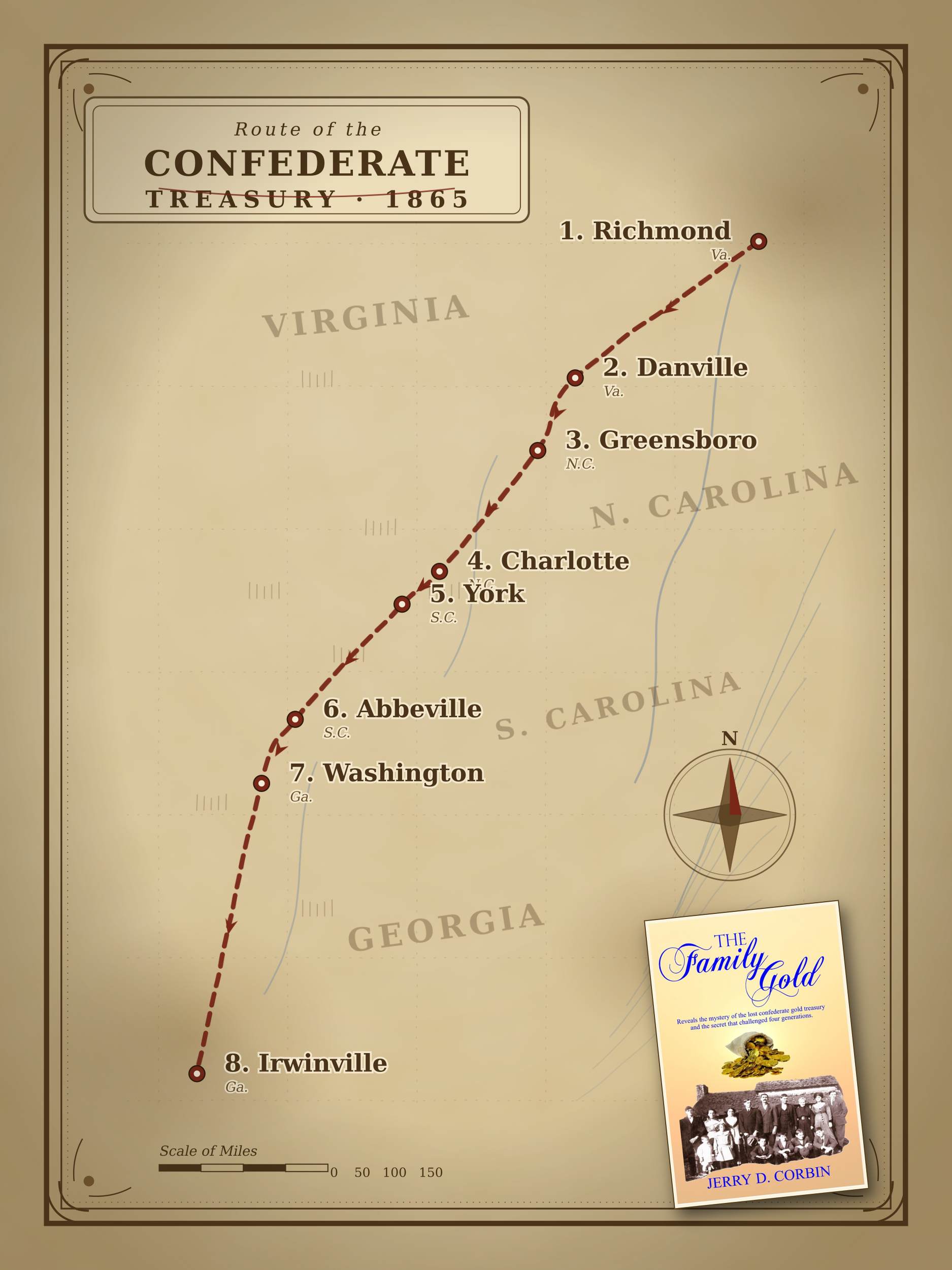
Places shown—not verified treasury stops
Every place below appears in the illustration. Inclusion and order are not evidence that treasury funds stopped there.
- RichmondVirginiaIllustrated place; not a verified treasury stop
- DanvilleVirginiaIllustrated place; not a verified treasury stop
- GreensboroNorth CarolinaIllustrated place; not a verified treasury stop
- CharlotteNorth CarolinaIllustrated place; not a verified treasury stop
- YorkSouth CarolinaIllustrated place; not a verified treasury stop
- AbbevilleSouth CarolinaIllustrated place; not a verified treasury stop
- WashingtonGeorgiaIllustrated place; not a verified treasury stop
- IrwinvilleGeorgiaIllustrated place; not a verified treasury stop
Sourced context
The National Park Service places Lee’s retreat from Petersburg on April 2 and Union entry into Richmond on April 3, 1865. The Library of Congress places Jefferson Davis’s capture near Irwinville on May 10 and describes cabinet members taking payment from treasury gold while disbanding. Together, these institutional summaries provide context for the first and last locations pictured; they do not verify all eight places as a shipment itinerary.
Sources & Further Reading
- Richmond, Embattled Capital, 1861–1865 — National Park Service
- Today in History — May 10: Jefferson Davis Captured — Library of Congress
Review what these sources support and where their limits begin.
Read the deeper introduction, Confederate Gold: Separating History from Legend, or consult the limited historical timeline.
About This Research
Jerry D. Corbin is an author and storyteller whose work draws on family history, historical events and fiction. These pages are site-curated reference material. They do not claim that Jerry has established an original, verified treasury route, and they do not present him as holding academic credentials.
Family history connects his storytelling to this subject. The Family Gold combines that family inspiration with historical context and imagined narrative; the novel is not offered as independent evidence for a treasury route.
Claims are separated using the labels below so that a sourced event is not confused with a later story or a fictional narrative.
- Documented history
- A specific claim tied to a named source. The claim must stay within what that source actually supports.
- Disputed account
- An account whose interpretation or evidentiary basis remains contested. It must be attributed, not presented as a settled finding.
- Legend
- A story that persists in later retellings. Longevity or popularity does not establish its historical truth.
- Family story
- Personal or inherited memory, identified as such rather than treated as independent archival corroboration.
- Fiction
- The imagined narrative of a novel. The Family Gold is not a documentary account or a claim to have solved the treasury’s fate.
Share this resource
Cite This Resource
The Confederate Treasury Trail. JerryCorbin.com editorial. Updated September 20, 2026. https://jerrycorbin.com/confederate-gold/treasury-map